
Deep Seabed Mining
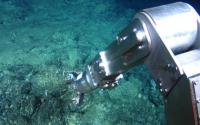
Deep sea mining is a relatively new mineral retrieval process that takes place on the ocean floor. Ocean mining sites are usually around large areas of polymetallic nodules or active and extinct hydrothermal vents at about 1,400 - 3,700 m below the ocean’s surface. The vents create sulfide deposits, which contain valuable metals such as silver, gold, copper, manganese, cobalt, and zinc. The deposits are mined using either hydraulic pumps or bucket systems that take ore to the surface to be processed.
Quicktabs: Keywords
Deep seabed mining interests like DeepGreen have often argued for the environmental and social benefits of mining maganese nodules over land-based methods, especially for the valuable cobalt minerals that will be necessary for any push to build more electric vehicles. To help assess and mitigate the environmental impact of any potential deep seabed mining, two expeditions will be traversing the CCZ to test undersea mining technologies and how much damage they cause to the deep seabed.
[ More ]The author argues that "[f]rom almost any perspective, seabed mining of metals is better for the environment, social justice issues and economics."
[ More ]Miners are pushing hard to extract metals from the ocean floor, but there is mounting concern about what it might do to the marine environment.
[ More ]The deep oceans, once thought to be lifeless, are home to many extraordinary creatures. But now the deep seabed mining boom threatens their – and our – existence by imperiling the ecosystems that are critical for regulating the global climate.
[ More ]Deep-sea mining has been given the go-ahead to commence in two years, after the tiny Pacific island nation of Nauru notified the UN body governing the nascent industry of plans to start mining.
[ More ]In its initial 'National Blueprint for Lithium Batteries', the U.S. Department of Energy has outlined plans to try and move lithium battery production away from reliance on problematic source of nickel and cobalt, a move that would impact the market for deep seabed mining.
[ More ]The tiny Pacific nation of Nauru has created shockwaves by demanding that the rules for deep sea mining are agreed in the next two years. Environmental groups warn that this will lead to a destructive rush on the mineral-rich seabed "nodules" that are sought by the mining companies.
[ More ]Canadian startup DeepGreen is touting seabed mining as a green alternative to land-based mineral extraction but scientists warn that seabed mining could result in environmental damages “irreversible on multi-generational timescales.”
[ More ]African countries, many of which are heavily reliant on mining, have criticised a move by the tiny Pacific island nation of Nauru to fast-track international negotiations over deep-sea mining, an industry that could hurt their economies.
[ More ]Polymetallic nodules coat fields of the ocean floor and are rich in critical minerals needed to make batteries for electric vehicles but marine and climate scientists warn that there is not enough data yet to determine if this would be the greener option.
[ More ]Pages
No results for this keyword.