
Deep Seabed Mining
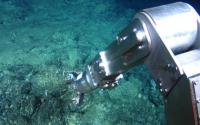
Deep sea mining is a relatively new mineral retrieval process that takes place on the ocean floor. Ocean mining sites are usually around large areas of polymetallic nodules or active and extinct hydrothermal vents at about 1,400 - 3,700 m below the ocean’s surface. The vents create sulfide deposits, which contain valuable metals such as silver, gold, copper, manganese, cobalt, and zinc. The deposits are mined using either hydraulic pumps or bucket systems that take ore to the surface to be processed.
Quicktabs: Keywords
An interview with the director of the Indian National Centre for Ocean Information Services on India's plans for taking advantage of mineral deposits in the Indian ocean.
[ More ]
On Friday, China passed the country's first law on deep seafloor mining. The law is designed to protect the maritime environment and ensure sustainable exploitation of its mineral resources.
[ More ]The International Seabed Authority has signed its first exploration contract for seabed mining for 2016. The deal was signed with the U.K. Seabed Resources Limited (UKSRL) and involves a 15-year contract for the exploration of polymetallic nodules in the eastern part of the Clarion-Clipperton Fracture Zone in the Pacific Ocean west of Mexico.
[ More ]Although several countries, including Saudi Arabia and Sudan, have recently shown renewed interest in tapping mineral resources on the deep seabed, the costs of operating in the difficult environment deep waters pose will likely preserve subsea basins for a little while longer.
[ More ]As the future of seafloor mining is debated this week, here are five things you need to know about the risks and rewards of extracting precious metals and minerals from the ocean.
[ More ]
Pew Environment advocates for a precautionary approach to the emerging deep seabed mining industry, arguing that "[l]arge, ecologically important areas of the seabed should be closed to mineral extraction, and precautionary standards must be adopted by the ISA to minimize environmental damage where mining does occur."
[ More ]A new study finds that the Clarion-Clipperton Zone, the site of much interest for mining, "harbors one of the most diverse communities of megafauna to be recorded at abyssal depths in the deep sea" raising questions about the environmental impact of deep seabed mining.
[ More ]A slew of recent discoveries in the deep seabed of the Exclusive Economic Zone of the Cook Islands have indicated potential new sources of rare earth elements and scandium.
[ More ]Resource-hungry China is stepping up activity in one of the final frontiers of mineral wealth – the remote seabeds lying kilometres beneath the Indian and Pacific oceans.
[ More ]The emerging deep-seabed mining industry is making some environmentalists nervous as it could irreperably damage the fragile and undistrubed ecosystem on the abyssal plains.
[ More ]Pages
No results for this keyword.