
Russia

Quicktabs: Keywords
Several U.S. lawmakers are warning U.S. military leaders about the pace and scope of Russia’s Arctic militarization, including the addition new brigades, ships and airfields to the fast-changing region.
[ More ]Tensions have increased a notch in the Arctic with the news that the Russians have started a major military exercise in the region. Nearly 40,000 servicemen, 41 warships and 15 submarines will be taking part in drills to make them combat-ready—a major show of strength in a region that has long been an area of strategic interest to Russia.
[ More ]The author argues that "[t]he U.S. would be wise to ratify the United Nation Convention on the Law of Sea [UNCLOS], a convention that the U.S. Navy and coast guard already abide by, allowing the United States to utilize the international legal framework to successfully petition its case in the Arctic. In a world growing in tensions between old foes, the Arctic could prove an opportunity to cool down tensions and rebuild trust between the West and Russia."
[ More ]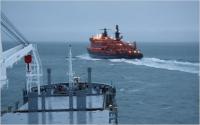
The author argues that the U.S., Canada, and Russia would all benefit economically and strategically from greater cooperating together to establish safe, secure and reliable Arctic shipping.
[ More ]
The author evaluates the expanding cooperation between India and Russia in the Arctic and argues that "[w]hile the Arctic might not seem like a priority for many Americans, it should not be overlooked as an important region for salvaging the U.S.-Russian relationship."
[ More ]Washington does not think that Russia is militarizing the Arctic, US Special Representative for the Arctic Admiral Robert J. Papp, Jr. told TASS in an exclusive interview on Wednesday.
[ More ]Norwegians are cautiously watching Russia's military buildup in the Arctic, and while they would rather prepare quietly than stoke fears of a Crimean-style Russian grab in the Arctic, the country's memory of the Nazi invasion 75 years ago remains fresh.
[ More ]Russia has submitted its bid for vast territories in the Arctic to the United Nations, the Foreign Ministry said Tuesday. The ministry said in a statement that Russia is claiming 1.2 million square kilometers (over 463,000 square miles) of Artic sea shelf extending more than 350 nautical miles (about 650 kilometers) from the shore.
[ More ]
Republican U.S. Sen. John McCain of Arizona said that Russia has become a "national security issue" for the U.S. in an interview Friday with Politico's Morning Defense team. His comments were made ahead of a congressional delegation trip he has been planning to the Arctic as a response to a rapidly growing Russian military presence off the coast of Northern Europe.
[ More ]Pages
Second, when Russia’s security moves in the Arctic are placed in the context of the nation’s larger trend to reform and modernize its armed forces, they appear less grandiose. In 2008, Russia embarked on one of the most ambitious military reforms, reorganization, and equipment modernization programs in its history, in which the Arctic is but one component. The plans call for more than 20 trillion rubles ($650 billion) by 2020 to completely overhaul its military hardware so that “by 2015, the proportion of the new generation of weapons should be 30 percent, and by 2020 reach 70-100 percent.”15 In contrast to other post-Soviet efforts, the current program has considerable political will behind it as evidenced by overall military spending in 2012 increasing by 24 percent – a jump of nearly $90 billion or 113 percent from 2003 military expenditures.16 Military spending is envisioned to jump 18 percent in 2014 and 60 percent from 2014-2016. The defense budget portion of the Russian GDP is envisioned to grow from 3.1 percent in 2012 to 3.9 percent in 2016.
What is certain, however, is that the Russian Arctic-based Northern Fleet is continually “stalked” by American (and perhaps British and French) fast-attack submarines from the moment the Russian sub- marines leave port. While, as noted above, the number of Russian “boomer” patrols has sharply declined since the days of the Cold War, the underwater games of “cat and mouse” continue as before, and several near-collisions have been reported as the Russian subs become increasingly successful in shaking off their American “tails.”54 The Cold War is not entirely over beneath the rapidly melting Arctic ice, and Russia’s nuclear submarine bases north of the Arctic Circle are yet another powerful signal that the Russians intend to enforce their claims in the Arctic. So, while the prospects of major progress on U.S.- Russian bilateral disarmament have never been brighter, the gradual rebuilding of the Russian Northern Fleet’s roster of ballistic missile submarines and the ongoing mission of American SSN’s to track them aggressively has meant increased rather than decreased U.S.-Russian naval competition.
By just about any measure, Russia is an Arctic superpower. It has an enormous coastline, a significant number of people living above the Arctic Circle, six nuclear-powered icebreakers in the region, and industrial centers in Nikel and Norilsk (which produce a high volume of industrial pollution).
Russia used to play up this status, staging large-scale annual conferences, graced by President Vladimir Putin’s presence. Not anymore, and it is not just the fallout from the Ukraine crisis that has poisoned that climate of cooperation. Russia has experienced two major setbacks in its vision for “conquering” the High North.
The first setback came from the seriously reduced value of the natural resources that are presumed to be hidden in the depths of the Arctic shelf. Putin’s lieutenants—including Nikolai Patrushev, the secretary of the Security Council of Russia—loved to engage in speculations about the fierce competition for access to the rich oil and gas fields that were certain to be discovered there. The problem is not only that the U.S. and EU sanctions have made it impossible for the state-owned oil giant Rosneft to continue the exploration of Arctic seas. (Sanctions prevent the import of technology and know-how, and U.S. companies—such as Exxon Mobil—who had worked in partnership with Rosneft have left.) The real problem is that estimated production costs and low oil prices add huge liabilities to any off-shore project.
The second disappointment has to do with international maritime transit along the Northern Sea Route (called Sevmorput in Russian). Many politicians in Moscow expected that climate change would shrink the Arctic ice, increase the commercial viability of a shorter connection between China and Europe, and provide useful employment for Russian icebreakers. The problem is that the old Soviet infrastructure along the Sevmorput is so rotten that navigation in the difficult northern waters remains too risky. Egypt, in the meantime, has swiftly constructed the New Suez Canal, which offers a far more reliable route for tanker and container traffic.
Pages
No results for this keyword.