
Russia
Quicktabs: Keywords
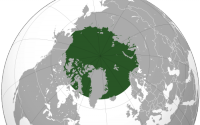
The Arctic, known better for its polar bears and melting sea ice than its fossil fuels, may soon become a hot spot for oil—spurring an international rush to stake claims on the seafloor.
[ More ]Russia's military said it planned to sail regular naval patrols along shipping lanes in its territory in the Arctic Ocean that opened to commercial vessels only in the last few years, as Arctic ice began melting at a record pace.
[ More ]Since 2007, in large part due to aggressive Russian posturing, the Arctic region has become a bone of contention among members of the Arctic Council as well as a subject of international concern. While the signing of the Russo-Norwegian treaty on September 15 put an end to disputes over seabed and maritime borders between two claimants of the region, the Arctic issue has seen the emergence of a critical Asian dimension as it becomes the source of cooperation as well as simmering tension between Russia and China.
[ More ]
Russia’s state nuclear corporation Rosatom is working on a roadmap exploring where to build final repositories for nuclear waste. Ten pre-selected locations in Northwest-Russia are now under consideration, including permafrost sites on Novaya Zemlya and Nenets Autonomous Okrug. Norway wants to have a say before any decisions are taken.
[ More ]Russia has said it will not comply with the ruling of a United Nations-backed court that ordered it to release a Greenpeace ship it seized in September with all crew, a Kremlin official said on Saturday. “We won’t [react]. We have no plans to participate in this process,” Sergei Ivanov, who heads the Kremlin administration said.
[ More ]President Vladimir Putin has ordered Russia’s armed forces to expand their presence in the Arctic region, one day after Canada confirmed its intent to lay claim to the sea bed under the North Pole.
[ More ]The author notes that in contrast to the pessimistic accounts of a pending resource war in the Arctic, "the most significant development in the Arctic today is the ever-increasing level of international cooperation – especially between Russia and the NATO countries."
[ More ]The International Tribunal for the Law of the Sea (ITLOS) dealt a blow to the Russian Federation on November 22nd, when it ordered Moscow to release the Arctic Sunrise and the remainder of the Greenpeace protestors who were on the vessel when Russia seized it on September 19, 2013. Shortly after the tribunal’s decision was announced, however, the Voice of Russia reported that the Russian government does not intend to comply with the order.
[ More ]Russian leaders now primarily see the Arctic as a potential source of economic growth for the country, both as a strategic resource base for the future and a potential maritime trade route.
[ More ]
Scholars these days are busy seeking to divine China’s intentions in the Arctic. Meanwhile, though, Japan and Russia have taken discreet – though decisive – steps to secure good relations and a better foothold in each other’s backyards.
[ More ]Pages
The resource race of the 21st century requires that nations seek resources from every corner of the globe to meet growing demand.169 The seas—long considered valuable sources of minerals, food, and now, energy—are no exception.170
Not surprisingly, nations are racing to stake a claim to these resources.171 Russia made a bold move in August of 2007 by planting a flag on the Arctic Seacap at the North Pole in an attempt to reinforce claims it has been making since 2001 that it owns the resources on the floor of the Arctic Ocean.172 The Arctic Seacap is an especially sought after area since it “may hold billions of gallons of oil and natural gas—up to 25 percent of the world’s undiscovered reserves”173 and is rapidly melting, making it navigable for the first time.174 Russia’s actions met immediate resistance from members of the international community, and have sparked debate over the resources the sea holds and who their lawful owner is.175 In fact, one journalist commented that “[t]he polar dive was part publicity stunt and part symbolic move to enhance [Russia’s] disputed claim to nearly half the Arctic seabed.”176
Much of the supposed distress voiced by UNCLOS proponents stems from Russia’s 2001 submission to the CLCS, in which Russia laid claim to a vast area of Arctic ECS. The proponents incorrectly imply that Russia’s claim will result in the loss of Arctic resources that rightfully belong to the United States. According to Senator Lisa Murkowski (R–AK), for example:
[I]f we do not become a party to the treaty, our opportunity to make [a claim to the CLCS] and have the international community respect it diminishes considerably, as does our ability to prevent claims like Russia’s from coming into fruition. Not only is this a negligent forfeiture of valuable oil, gas and mineral deposits, but also the ability to perform critical scientific research.30
However, Russia’s 2001 submission to the CLCS in no way overlaps or infringes on potential areas of U.S. ECS in the Arctic. To the contrary, Russia’s claim adheres to a boundary line that the United States and the USSR agreed upon in a 1990 treaty.31 Specifically, Russia’s submission to the CLCS divides its claimed conti- nental shelf and ECS from the U.S. shelf along an agreed boundary line that extends from the Bering Strait northward into the Arctic Ocean.
Despite the slowdown, Russia continues to increase its military presence in the Arctic. The National Security Strategy of the Russian Federation until 2020 stresses the importance of strengthening border guard forces in the region and updating their equipment, while creating a new unit of military forces to “ensure military security under various military-political circumstances.”78 Russia’s assertive rhetoric has been matched by a range of steps that stake its military prominence in the Arctic by developing its coastal defense infrastructure and enhancing its technology capa- bilities, which have been perceived by its Arctic neighbors as provocative and controversial. For example, Russia fired cruise missiles over the Arctic in a summer 2007 exercise; reinforced its Northern Fleet in order to perform additional exercises in the summer of 2008; tested new electronic equipment and precision weapons; and resumed Arctic patrols for the first time since the end of the Cold War. Several times during the past two years U.S. and NATO jets have shadowed Russian bombers close to the Norwegian and Alaskan coasts, particularly during and after the Georgia-Russia conflict in August 2008.
From Russia’s security strategy,40 and evidence of Russia’s pragmatism in its approach to the Arctic, it is possible to draw two broad security conclusions: First, Russia is unlikely to engage in any military confrontation that could potentially damage its economic security. This is consistent with Russia’s broadly conciliatory approach to the Arctic, despite its often-inflammatory rhetoric, and symbolic actions such as placing a Russian flag on the seabed beneath the North Pole. Russia’s approach is underpinned by a belief that it has both the law, and scientific evidence in its favour, and that it therefore has a legal right to a significant unclaimed portion of Arctic seabed, particularly along the Lomonosov Ridge. If Russia’s claim to the CLCS is eventually successful, it stands to gain approximately 460,000 square miles, or half of the Arctic’s seabed and the rich resources contained therein.41 The second conclusion this author can draw is that should Russia fail to gain the Arctic resources it expects through legal and procedural means, there is so much at stake in terms of Russia’s economic security, that other Arctic actors need to plan for the contingency that Russia might attempt to assert its control over Arctic resources and territory through alternate means.42
Finally, is there a “Russian question” looming behind all of these issues? Whether we choose to proceed by strengthening and extending the existing framework where we must, or to develop new solutions, will Russia choose to participate within that system? As noted at several points above, Russia, by and large, is already doing so. Moreover, Russian officials have been at pains to counteract the characterization of the Arctic described at the beginning of this article: the faulty notion of the Arctic as a future battleground between Russia and the West. For example, the Russian Foreign Ministry has publicly stated that discussion of “a possible military conflict for Arctic resources is baseless” and that the problems facing the region will be resolved “on the basis of international law.”97 Even the provocative figure at the head of Russia’s North Pole expedition has sought to downplay the situation, remarking that “[n]obody’s going to war with anybody” and that while Russia will “defend [its] economic interests . . . a conflict in the near future” is unlikely.98 Moreover, the United States has largely acknowledged that Russia is adhering to the applicable rule of law, in particular with respect to the extended continental shelf.99 Simultaneously, Russia appears to be engaged with the international community when it comes to the Arctic: through the Arctic Council, through the IMO, and in bilateral and multilateral efforts with its fellow Arctic states.100
In August 2007, Russian scientists descended 4,261 meters (13,976 feet) beneath sea level at the North Pole, using two dual-manned submers- ibles, Mir-1 and Mir-2.18 The mission had two purposes: first, to collect samples of soil from the seabed directly beneath the North Pole, which is within the claims that Russia submitted to the commission and along the Lomonosov Ridge; and second, to place a one meter tall titanium Russian Federation flag, creating nationalist symbolism behind Russia’s claim and reinforcing its dedication to being a major power, both scientifically and economically, in the Arctic region.
Because of the suddenness of the claim by Russia, four other countries with a potential stake (Denmark, Norway, the United States, and Canada), and one without a stake (Japan), have submitted written responses to the Commission. Denmark and Canada have both refused to offer an opinion immediately after Russia’s submission, citing the necessity of additional and more specific data.19 The remaining countries, the United States, Norway, and Japan,20 have offered negative responses. Norway, having submitted a claim in November 2006 (beyond their 200 nautical mile EEZ) that does not overlap with Russia’s claim, was most concerned with overlapping claims along mutual borders, a “maritime dispute” that has not yet been settled and which could be problematic for both countries.21 The United States submitted a detailed response, using scientific data to support a position that neither the Alpha-Mendeleev or the Lomonosov Ridges are part of any state’s continental shelf, but are rather independent features consisting of magma or freestanding formations. The official U.S. position advised:
The integrity of the Convention and the process for establishing the outer limit of the continental shelf beyond 200 nautical miles ultimately depends on adherence to legal criteria and whether the geological criteria and interpretations applied are accepted as valid by the weight of informed scientific opinion. A broad scientific consensus of the relevant experts... is critical to the credibility of the Commission and the Convention.22
This statement suggests that the United States would like the convention and commission to look strongly and carefully at the evidence presented by Russia before determining any course of action. It also indicates that the United States is first deferring to the standards established in UNCLOS for dispute settlement, despite not being a signatory to the agreement.
The United States was able to play a role in the Commission’s non- acceptance of Russia’s first claim to the Arctic seabed back in 2001, even though it was not a party to LOST – and, therefore, not at risk of being bound by adverse Commission decisions. This episode demonstrates that, by remaining outside of the Treaty, America can retain its freedom of action (including the use of bilateral diplomacy and more constructive multilateral mechanisms, such as the Arctic Council) and still challenge such over-reaching Russian claims and win.
The geopolitics of the twenty-first century will be different from the days of empire and conflict of the nineteenth and twentieth. The increased accessibility of the Arctic, with its energy and mineral resources, new fisheries, shortened sea routes, and access to rivers flowing north to the Arctic, is pushing Russia to become a maritime state. As it progresses, Russia will no longer be susceptible to geographic isolation or encirclement. At the same time, these changes will require Russia to become more closely integrated into global commercial and financial networks, to welcome international business involvement, and to par- ticipate in international bodies that harmonize international shipping, safety, security, and environmental regulations.
These changes are already opening the way for a new geostrategy that has its roots in the geopolitical thinking of the twentieth century but addresses the changes that are turning the Arctic from an afterthought to a central front in the new geopolitical view of the world. In this new geostrategy, Russia assumes a role as one of the maritime powers of the “rimland,” and the Russian Arctic becomes a new geographical pivot among the great powers. Decades will pass before Russia can fully make the shift from Eurasian heartland to Arctic coastal state, but it is already integrating policies toward this end into the strategies of its national security council and federal ministries, and it shows every indication of expecting to seize its future seat among the major maritime states of the world.
Foreign Policy. In seeking to establish the Arctic as a “zone of peace and cooperation,” the Russian Arctic policy emphasizes mutually beneficial bilateral and multilateral cooperation among Russia and other Arctic states on the basis of in- ternational treaties and agreements to which Russia is a party. Underlying all Russian policies toward the Arctic is support for regional collaboration in the Arctic and commitment to UNCLOS and multilateral organizations and approaches, including the International Maritime Organization, the Arctic Council, and the five Arctic coastal states, who met in Ilulissat, Greenland, in 2008 to issue their declaration on management of the Arctic. The key foreign policy point in the Ilulissat Declaration—that the Arctic coastal states will resolve disputes peacefully in line with the law of the sea—is consistent with the Russian Arctic policy.22
Pages
Tension between Russia and other Arctic nations will remain high as they continue to compete for Arctic territory. Maintaining UNCLOS as a viable legal framework for settling Arctic territorial claims should help avert potential confrontations between Russia and other UNCLOS members.
- U.S. participation in UNCLOS necessary to resolve Arctic dispute between Russia and Norway
- USNWC war game found U.S. non-ratification of UNCLOS risks U.S. being replaced by Russia as the leader in Arctic
- Russia's use of CLCS to validate its claim over Lomonsov ridge is an example of their use of lawfare to the disadvantage of the US
- Abandoning UNCLOS framework in Arctic could lead to military confrontation with Russia, working within framework best way to resolve disputes
- ... and 17 more quote(s)
Strategic environment and level of cooperation between Russia and the United States in the Arctic will be based on the state of their bilateral relations in general, and not on the U.S. decision of whether or not to ratify the UN Law of the Sea.
- US ratification of UNCLOS will not boost capacity to challenge Russian claims, disputes likely to be resolved outside of convention
- Russia will defend its claims in the Arctic but is unlikely to resort to military means
- Bilateral relations between U.S. and Russia will be more important to Arctic security than U.S. non-party status to UNCLOS
- Russia has effectively removed option of resolving border disputes through UNCLOS in its signing statements under Article 298
- No major disagreement over ECS claims between U.S. and Russia
- Arctic nations are only cooperating through international institutions out of political convenience