
Deep Seabed Mining
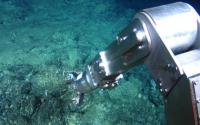
Deep sea mining is a relatively new mineral retrieval process that takes place on the ocean floor. Ocean mining sites are usually around large areas of polymetallic nodules or active and extinct hydrothermal vents at about 1,400 - 3,700 m below the ocean’s surface. The vents create sulfide deposits, which contain valuable metals such as silver, gold, copper, manganese, cobalt, and zinc. The deposits are mined using either hydraulic pumps or bucket systems that take ore to the surface to be processed.
Quicktabs: Keywords
On Wednesday, the Center for Biological Diversity announced it has settled a federal court lawsuit against the National Oceanic and Atmospheric Administration and its parent agency, the U.S. Department of Commerce, in a move that will compel federal officials to conduct in-depth assessments of the risks to wildlife and underwater ecosystems before issuing permits for the exploration of the ocean floor for rare-earth metals and minerals.
[ More ]
A scientific expedition has been launched from the UK to explore the mining of rich metal deposits on the deep ocean floor, which are the focus of a new gold rush around the world.
[ More ]Deep seabed mining for the rare earth minerals necessary for electronic devices like smartphones will expose deep dwelling sea creatures and their fragile ecosystems to new dangers from mining operations.
[ More ]An international group of marine scientists published an article in Science in which they outlined the desperate need for an international effort to regulate the ocean floor, in order to preserve the deep sea's unique and largely uncharted ecosystems. The article came in response to the growing threat to these ecosystems from commercial deep sea activities, particularly deep sea mining.
[ More ]Ambitious research aims to limit environmental damage on the sea floor – but some scientists fear mining this pitch black world will do more harm than good.
[ More ]Biodiversity losses from deep-sea mining are unavoidable and possibly irrevocable, an international team of 15 marine scientists, resource economists and legal scholars argue in a letter published today in the journal Nature Geoscience.
[ More ]The risk of running out of rare earth metals that are essential to modern technology has led to a surge in interest in mining the deep seas.
[ More ]Asteroid mining has gained steam in the popular psyche: who doesn't love the idea of flying up to one of the giant rocks flying by and somehow harvesting it of its precious metals like platinum. But today at the 2017 meeting of the American Association for the Advancement of the Sciences, scientists considered whether we should pursue another, far more likely alternative: mining the seafloor.
[ More ]A new international study has demonstrated that deepsea nodule mining will cause long-lasting damage to deepsea life. This study, led by scientists at the National Oceanography Centre (NOC) in the U.K., was the first to review all the available information on the impacts of small-scale sea-floor disturbances simulating mining activity.
[ More ]A new gold rush is targeting rich ores on the ocean floor containing valuable metals needed for smartphones and green technologies, but also hosting exotic ecosystems, raising questions about whether deep seabed mining is really an ecologic alternative to land-based mining.D
[ More ]Pages
No results for this keyword.